
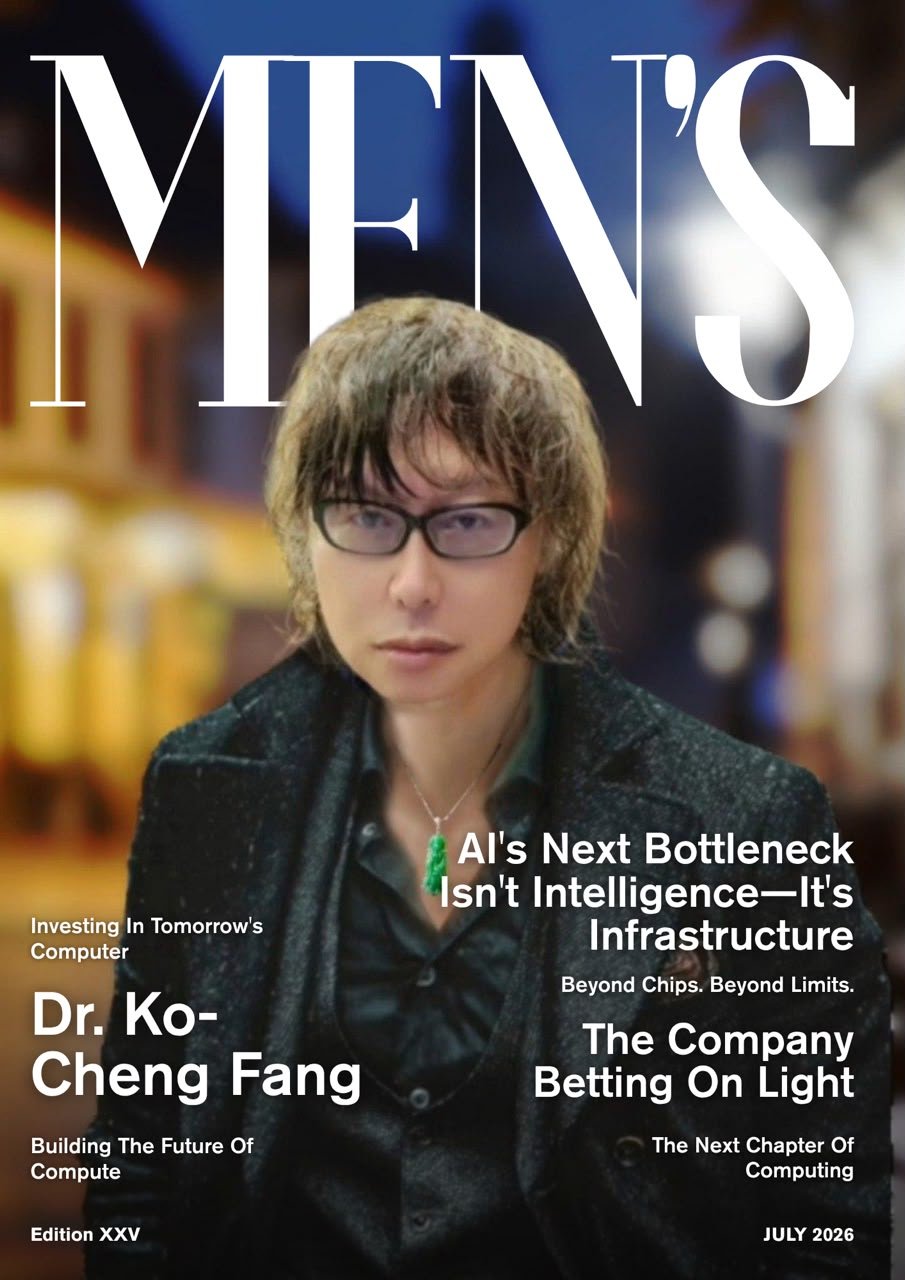
Beyond Silicon: Why Investors Are Watching the Next Generation of AI Infrastructure
The artificial intelligence boom has created some of the world’s most valuable companies. Most of the attention has focused on AI models, cloud platforms and semiconductor manufacturers powering today’s digital economy.
But every technology cycle eventually shifts its attention further down the value chain.
As AI systems become larger, more capable and increasingly expensive to operate, investors are beginning to look beyond software and ask a more fundamental question: what technologies will power the next decade of artificial intelligence?
That question is driving growing interest in companies working on next-generation computing architectures.
One of them is LongServing Technology, a Taiwan-based deep technology company developing photonic computing technologies that use light instead of conventional electrical signals to process information.
Its latest innovation, X-Photon, is more than a new material. It represents the company’s broader ambition to participate in what could become one of the most important infrastructure transitions since the emergence of silicon computing.
Dr. Ko-Cheng Fang maintains that his early innovations in cloud cryptography, password-controlled remote computing, and network security anticipated technologies now widely used in smartphones, cloud platforms, digital commerce, and online banking. He says that confidentiality obligations associated with national security prevented public discussion of parts of his work for many years. Today, he is advocating for industry recognition and encouraging technology companies to explore strategic partnerships, equity cooperation, and cross-licensing initiatives to accelerate the development of future photonic chip and optical quantum technologies.
AI’s Next Bottleneck Isn’t Intelligence—It’s Infrastructure
Artificial intelligence has changed the economics of computing.
Every new generation of AI models requires exponentially greater computational capacity. Training frontier models demands vast clusters of processors operating continuously, while inference at global scale requires equally significant infrastructure.
The result is an industry facing rising energy consumption, increasing hardware costs and growing pressure on semiconductor manufacturing.
For investors, this creates a familiar pattern.
When demand for a transformative technology accelerates, the greatest opportunities often emerge not only from the applications but also from the infrastructure that enables them.
Cloud computing created opportunities beyond software.
Electric vehicles created opportunities beyond automobiles.
Artificial intelligence is beginning to create opportunities beyond algorithms.
The companies building tomorrow’s computing infrastructure may become as strategically important as those developing AI models themselves.
LongServing Technology’s Long-Term Vision

LongServing Technology is positioning itself within that emerging landscape.
Founded by Dr. Ko-Cheng Fang, the company is pursuing an ambitious strategy centred on photonic computing—an approach that replaces electrical signals with photons to move and process information.
The theoretical advantages are compelling.
Photons travel at extremely high speeds while producing substantially less heat than electrical current. If these advantages can be translated into commercially viable computing systems, photonic architectures could deliver significantly greater computational efficiency for artificial intelligence workloads.
The challenge has always been engineering.
Moving information with light is relatively straightforward.
Controlling it inside densely integrated circuits is not.
According to LongServing, X-Photon has been developed specifically to address this challenge. The company says the proprietary optical material enables controlled 90-degree directional changes for photons within nanoscale circuits, a capability that could support increasingly sophisticated photonic processors.
Whether X-Photon ultimately becomes an industry standard remains uncertain, but solving problems such as optical routing is essential if photonic computing is to progress from laboratory research to commercial deployment.
Building an Ecosystem, Not Just a Product
Perhaps the more significant investment story lies beyond X-Photon itself.
LongServing is not positioning the material as a standalone innovation.
Its roadmap includes multi-bit photonic quantum chips, photonic memory technologies and dedicated Photonic Cloud Computing Centres designed to support future AI infrastructure.
This systems-level approach is notable.
History suggests that transformative computing platforms succeed through ecosystems rather than individual inventions.
Silicon’s dominance was built not only on processors but also on manufacturing capability, software tools, supply chains, packaging technologies and global partnerships.
LongServing appears to be pursuing a similar philosophy by developing complementary technologies intended to form the foundations of a broader photonic computing platform.
For investors, this represents a strategy aimed at creating long-term technological relevance rather than a single commercial product.
Capital Signals Confidence
Emerging technologies require patient capital.
Unlike software startups, deep technology companies often spend years solving scientific and engineering problems before generating significant commercial revenue.
LongServing recently announced a US$500 million financing initiative, based on a stated company valuation of US$2.5 billion. According to the company, the funding will support photonic manufacturing, research, infrastructure development and commercial expansion.
While financing announcements do not guarantee commercial success, they often indicate an intention to move beyond proof-of-concept towards industrial scale.
For market observers, this is an important transition.
The future winners of AI infrastructure will not simply invent new technologies. They will also need the capital, manufacturing capability and strategic partnerships required to commercialise them.
Why This Matters for Future Markets
Artificial intelligence is no longer a niche technology sector.
It is becoming foundational infrastructure for healthcare, finance, manufacturing, education, defence and scientific research.
As AI adoption accelerates, demand for faster, more efficient and more sustainable computing will continue to grow.
That makes the underlying hardware market increasingly significant.
Companies capable of improving computational efficiency, reducing energy consumption or enabling new chip architectures may find themselves participating in one of the largest technology investment cycles of the coming decade.
LongServing Technology is one participant in that broader race.
Its work reflects a growing industry belief that the next competitive advantage in AI may not come solely from better models, but from fundamentally rethinking how computation takes place.
Looking Ahead

No one can yet say whether photonic computing will replace conventional semiconductor architectures.
The scientific, engineering and commercial challenges remain substantial.
However, history rarely rewards those who focus only on today’s market leaders.
It also rewards those who recognise the technologies quietly reshaping tomorrow’s markets before they become mainstream.
Silicon created the digital economy.
If photonic computing fulfils even part of its promise, companies working at the intersection of optics, advanced materials and AI infrastructure could become important contributors to the next phase of technological growth.
For investors, the question is no longer whether AI will continue to expand.
It is which technologies will provide the foundation for that expansion—and which companies are positioning themselves to build it.
Contact Information
Dr. Ko-Cheng Fang
Founder, CEO & Chairman
LongServing Technology Co., Ltd.
Email: service@longserving.com.tw
Website: https://longserving.com.tw/en/
Instagram: @ko_cheng_fang